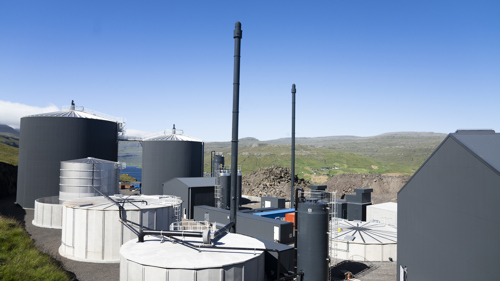

What is a biogas plant?
A biogas plant is a plant, which transformes organic waste into biogas. With help from bacteria the organic waste is broken down in a oxygen-free environment and the process is speeded up by heating the materials in a reactor, a process called anaerobic digestion. The biogas plant, Förka, is reciving reneweble waste, mostly excrement and cow-manure from the sea farming industry and agriculture in the Faroe Islands. The solid in the organic waste contains carbon, which turns into biogas and which is made of methane (CH4) and carbon dioxide (CO2). The excrement and manure are mixed in the tanks before heating the biomass to 38-52°C and before pumping it into the reactor, where the biogas eventually is made. The biomass is digested for approx. three months in the reactor, where it transformes into a bio-liquid fertillizer, which can be used for fertilization in agriculture. Because the bio-manure is processed, the odor smells less and the amount of emitted greenhouse gases are less. By using the bio-manure instead of the normal manure, Förka protects the environment in the best possible way. The biogas is used to make power and district heating for households, which is made in a gasengine placed at the biogas plant. The power is transferred to the power-grid and the heat is used locally.
The biogas plant has the capacity to produce power, corresponding to the consumption of 1,900 households and district heating for 400 households. Furthermore, the biogas plant saves approx. 11,000 tons of CO2 annually and approx. 40-45,000 tons of the bio-liquid fertillizer processed at the plant is given back to the farmers.